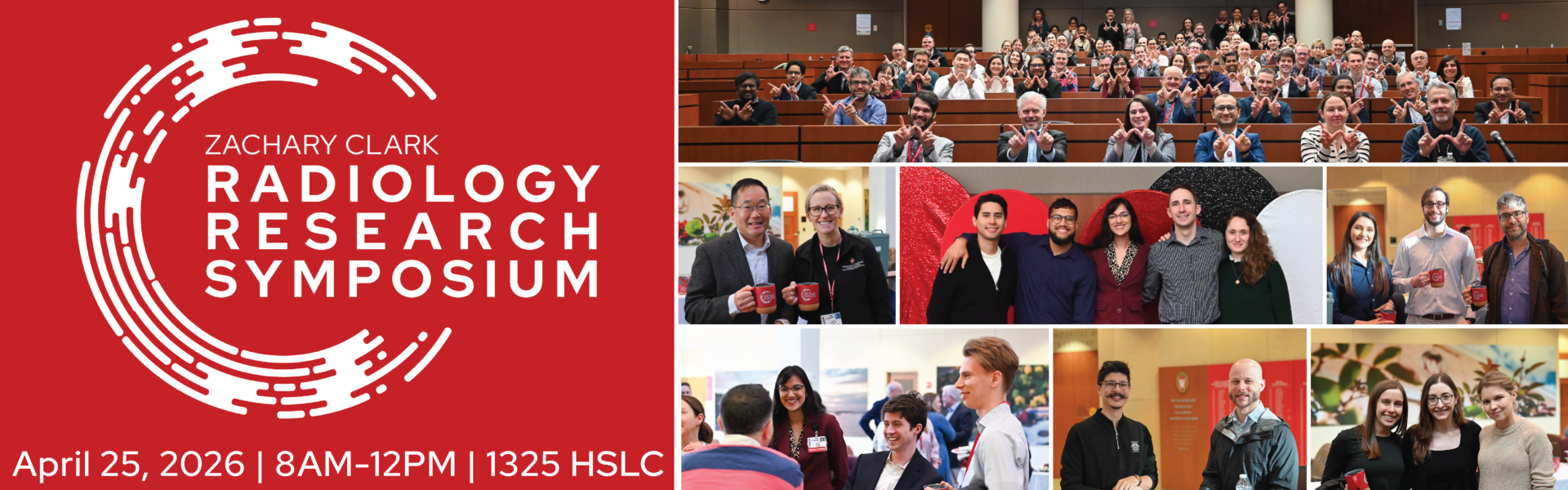
Saturday, April 25, 2026
8:00AM-12:00PM
Health Sciences Learning Center
Register Now!
Sponsored by the UW Department of Radiology, the annual Zachary Clark Radiology Research Symposium held in spring celebrates the high-caliber radiology research conducted by our medical students, residents, and fellows. It also embodies the department’s dedication to both research and education.
Register for the symposium on April 25, 2026 to see our residents, fellows and medical schools present their research!
Program & Keynote Address
Program Schedule
| 8:00 – 8:30AM | Continental Breakfast |
| 8:30 – 8:45AM | Welcome & Introduction Christoph Lee, MD, MS, MBA, Vice Chair or Research Allison Grayev, MD, Co-Moderator Venkata (Vinny) Meduri, MD, Co-Moderator |
| 8:45 – 10:15AM | Oral Presentations |
| 10:15 – 10:45AM | Electronic Exhibits & Scientific Posters Viewing |
| 10:45 – 11:45AM | “The Innovator’s Mindset in Medical Imaging” Christopher Hess, MD, PhD Keynote Speaker |
| 11:45AM – Noon | Recognitions & Concluding Remarks |
Keynote Address
“The Innovator’s Mindset in Medical Imaging”
Christopher Hess, MD, PhD
Alexander R. Margulis Distinguished
Professor and Chair
Department of Radiology and Biomedical Imaging
UC San Francisco
 Read more about Christopher Hess.
Oral Presentations

Sarah Daggett, MD
Level: Resident
Faculty Mentor: Meghan Lubner, MD
Title: Diagnostic Yield of Image-guided Percutaneous Biopsies of the Bowel: A Multi-Institution Study
This is an accordion element with a series of buttons that open and close related content panels.
Abstract for Diagnostic Yield of Image-guided Percutaneous Biopsies of the Bowel: A Multi-Institution Study
Purpose
To evaluate the diagnostic yield and safety of percutaneous image-guided biopsies of bowel lesions.
Materials and Methods
Image-guided percutaneous biopsies of bowel lesions performed at five institutions from 2010-2024 were collected and reviewed. Demographic and procedural data were abstracted from the medical record, including review of the surgical pathology to determine if the biopsy result was diagnostic and concordant with the final diagnosis.
Results & Conclusion
103 bowel biopsies were evaluated (mean age, 62.7±15.7 years; M/F 54/49; mean BMI 27.3±6.8); these included targets in the stomach (n=13), small bowel (n=54), and colon and rectum (n=36). About half (52%, n=54) were performed using ultrasound (US) guidance only, while the other 48% (n=49) were performed using either computed tomography (CT) or a hybrid approach. Only 1 biopsy could not be performed due to technical factors. Of the remaining 102 biopsies, 85% (n=87/102) were core, 5% (n=5/102) were fine needle aspiration (FNA), and 10% (n=10/102) were both core and FNA. Overall median number of biopsy passes was 3.5. Average lesion size was 7.9±9.2cm in the longest axis (5.9cm median) and 4.1±2.2cm in the target plane (3.9cm median) on procedural imaging.
Diagnostic yield for all biopsies performed was 92% (n=90/98). Of note, 4 research study biopsies were excluded from this analysis because adequacy was unknown. Diagnostic yield was 93% (n=77/83) for core biopsies alone, 60% (n=3/5) for FNA alone, and 100% (n=10/10) for core and FNA combined. Of all diagnostic biopsies, 93% (n=84/90) were concordant with the patient’s ultimate diagnosis, which were primarily malignancies (86%, n=89/103). There were complications in only 6% (n=6) of biopsies, with 5/6 of those being minor, such as postprocedural pain or small hematoma. Conscious sedation was used in most procedures (58%, n=59).
Image guided percutaneous biopsy of the bowel provides an effective technique for obtaining a histopathologic diagnosis with a high diagnostic yield and low complication rate.
Kiara Didriksen
Level: Medical Student
Faculty Mentor: Anand Narayan, MD, PhD
Title: Transparency of FDA Cleared AI-Enabled Products in Radiology: A Scoping Review
This is an accordion element with a series of buttons that open and close related content panels.
Transparency of FDA Cleared AI-Enabled Products in Radiology: A Scoping Review
Purpose
Artificial Intelligence (AI) is increasingly integrated into radiology, yet concerns remain about transparency in reporting of training and validation datasets and performance across diverse populations. Cohort demographics such as sex, race, and geography are inconsistently reported, raising doubts about generalizability; and bias. This study evaluates the accessibility, clarity, and transparency of reporting training and validation cohorts for FDA-cleared AI-enabled radiology devices.
Materials and Methods
We conducted a scoping review of FDA-cleared AI-enabled radiology devices using FDA approval summaries and the ACR’s ARCH-AI database. A master spreadsheet captured device characteristics, approval pathways, performance in training and validation cohorts and demographic characteristics of those cohorts. Methods and analyses followed the PRISMA-ScR framework for conducting scoping reviews. An independent double-review system was implemented.
Results
777 FDA-cleared AI-enabled radiology devices were identified. The majority (99%, 768/777) were cleared via the 510(k) pathway. Nearly half (51%, 397/777) were classified as Software as a Medical Device (SAMD). Although ARCH-AI contained supplementary information for 38% (297/777) of devices, discrepancies in reporting persisted across sources. Training dataset characteristics were provided in 42% (326/777) of cases. Reporting regarding validation varied: 61% (475/777) reported model performance, 20% (146/777) disclosed sensitivity, 18% (131/777) specificity, and 11% (87/777) accuracy. Sample size was reported in 39% (306/777) of devices, and 24% (187/777) included reader studies. Demographic characteristics of cohorts were infrequently reported: sex distribution was documented for 20% (155/777) of cohorts, race or ethnicity information was reported for 12% (94/777), and geographic residence of cohorts was reported for 23% (179/777). Higher reviewer agreement (>90%) in variables such as sensitivity, specificity, race, ethnicity and gender. Moderate reviewer agreement in variables such as SAMD classification, training dataset reporting and scanner manufacturer.
Conclusion
FDA documentation of training and validation cohorts for AI-enabled radiology devices demonstrates substantial gaps in transparency, particularly for demographics such as sex, race, ethnicity, and geography. Inconsistent demographic information raises concerns about generalizability and bias of FDA-cleared AI technologies for radiology.

Katrina Falk, PhD
Level: Medical Student
Faculty Mentor: Paul Laeseke, MD, PhD
Title: Hepatic histotripsy after administration of ultrasound contrast; is it safe?
This is an accordion element with a series of buttons that open and close related content panels.
Abstract for Hepatic histotripsy after administration of ultrasound contrast; is it safe?
Purpose
During hepatic histotripsy, diagnostic ultrasound is used to identify and target tumors. Techniques to facilitate targeting poorly echogenic tumors are needed. Contrast enhanced ultrasound (CEUS) is commonly used to increase the conspicuity of liver tumors, however, the safety and efficacy of performing histotripsy after the administration of ultrasound contrast, which effectively lowers the cavitation threshold of the tumor and surrounding liver, is unknown. The purpose of this study was to assess the safety and efficacy of hepatic histotripsy after CEUS in an in vivo porcine liver model.
Materials and Methods
Six healthy, acute, female swine (mean weight, 52.3kg) each underwent two histotripsy treatments (2.0 cm diameter) of the liver. Following a control histotripsy treatment in either the right or left liver, ultrasound contrast (Lumason) was administered intravenously. After a 10-minute washout period (per manufacturer guidance), a second histotripsy treatment (post-CEUS) was performed on the contralateral lobe. Imaging (intra- and post-procedural) and gross necropsy were used to assess off target damage to determine safety. Efficacy was assessed by comparing planned and actual treatment zone dimensions on post-treatment MRI and by confirming cell death on histology. Confidence intervals (p=0.05) were used to compare differences in treatment zone sizes between control and post-CEUS.
Results
12/12 treatments were well demarcated and visible on post-treatment CEUS and MRI. No off-target cavitation was noted during treatment and there was no off-target damage on necropsy. One post-CEUS treatment was associated with mild T2 hyperintensity in the abdominal wall adjacent to the treatment zone without an identifiable pathologic correlate. Small, non-occlusive portal or hepatic thromboses were observed in 5/6 post-CEUS and 6/6 control treatments. The average difference (95% CI) between planned and actual dimensions of the treatment zone was 8.1mm (5.3,10.8), 6.4mm (1.6,11.2), and 7.7mm (0.9,14.4) for the post-CEUS treatments and 10.1mm (6.0,14.2), 6.0mm (-0.3,12.2), and 8.1mm (6.4,9.9) for control treatments. Complete cellular destruction was achieved within all histotripsy treatment zones.
Conclusion
In this in vivo swine model, hepatic histotripsy after CEUS was safe and effective, provided a 10-minute washout period is included before energy delivery.

Brendan Franz, MD
Level: Fellow
Faculty Mentor: Kenneth Lee, MD, MBA
Title: Hamstring T-Junction Injuries in D1 Collegiate Football Players: Are they worse off than non T-junction injuries regarding recovery time and re-injury rates?
This is an accordion element with a series of buttons that open and close related content panels.
Abstract for Hamstring T-Junction Injuries in D1 Collegiate Football Players: Are they worse off than non T-junction injuries regarding recovery time and re-injury rates?
Purpose
Distal hamstring strain injuries (HSIs) involving the T-junction represent an anatomically complex region. Prior studies have reported mixed evidence regarding their association with longer recovery time and higher rates of re-injury. We sought to determine the proportion of HSIs that involve the T-junction in NCAA D1 football players and compare return to sport (RTS) and re-injury occurrence with non T-junction HSIs.
Materials and Methods
IRB approval and informed consent were obtained. MRI and clinical data were collected at the time of HSI as part of a larger prospective cohort investigation of NCAA D1 football players. An MSK Radiologist graded each MRI using the British Athletics Muscle Injury Classification Grading System (BAMIC) and determined T-junction involvement. The proportion of HSIs with T-junction involvement was estimated using general estimating equations with robust confidence intervals (CI) to account for repeated observations among athletes. RTS was compared between T-junction and non T-junction HSIs, and by non T-junction BAMIC subgroups, using Cox proportional hazard models. The frequency of re-injuries was compared using Fisher’s Exact test.
Results
A total of 121 HSIs were included in the study with the proportion of T-junction injuries being 19.8% (95% CI: 12.2%, 32.2%). The median time to RTS was 25 days for T-junction injuries and 24 days for non T-junction injuries with no difference observed between the two injury types (hazard ratio: 0.99; 95% CI: 0.59, 1.68). Secondary analyses comparing all T-junction HSIs with non T-junction BAMIC a, b and c subgroups, separately, demonstrated no difference in RTS (p-values ≥ 0.10). No difference in re-injury frequency between T-junction and non T-junction injuries was observed (p-value = 0.29).
Conclusion
T-junction injuries represent approximately 20% of HSIs in D1 football players, but do not significantly alter the athlete’s time to RTS or re-injury occurrence.

Muhaison Ibrahim
Level: Medical Student
Faculty Mentor: Aaron Eifler, MD
Title: Prostatic Artery Embolization Facilitates Efficient Holmium Laser Enucleation of Prostates Greater than 200 Grams
This is an accordion element with a series of buttons that open and close related content panels.
Abstract for Prostatic Artery Embolization Facilitates Efficient Holmium Laser Enucleation of Prostates Greater than 200 Grams
Purpose
To evaluate whether prostatic artery embolization (PAE) prior to holmium laser enucleation of the prostate (HOLEP) improves procedural efficiency and reduces intraoperative complications in patients with benign prostatic hyperplasia (BPH) and prostate volumes exceeding 200 grams.
Materials and Methods
A retrospective cohort study was conducted on 13 male patients with symptomatic BPH who underwent PAE followed by HOLEP at a single academic center. Inclusion required a prostate volume >200g as confirmed by imaging. Clinical data including prostate-specific antigen (PSA) levels, American Urologic Association (AUA) symptom scores, and prostate volume were collected pre-intervention. PAE procedural parameters (duration, complications) and HOLEP metrics (operative time, enucleation efficiency in grams/minute, bleeding events) were recorded. Post-operative outcomes including catheter duration, hospital stay, voiding success, and complication rates were analyzed. Paired t-tests and Wilcoxon signed-rank tests assessed pre- vs. post-intervention differences, while linear regression analyzed enucleation efficiency relative to prostate volume reduction.
Results
All 13 patients successfully underwent PAE-HOLEP with no major embolization-related complications. Preliminary analysis showed a significant reduction in prostate volume following PAE and improved enucleation efficiency during HOLEP. Operative time was reduced relative to reported averages for large prostates, and intraoperative bleeding was minimal. Postoperative recovery was favorable, with early catheter removal and short hospital stays.
Conclusion
Preoperative PAE may serve as a valuable adjunct to HOLEP in patients with very large prostates, enabling more efficient tissue enucleation and reducing operative risk. These findings support a potential paradigm shift in the management of massive BPH.
Clinical Relevance Statement
Incorporating PAE before HOLEP in patients with prostates >200g may improve procedural outcomes and patient recovery, offering a safer and more effective strategy for treating extreme cases of BPH.
 Benjamin Prout, MD

Level: Fellow
Faculty Mentor: Giuseppe Toia, MD, MS
Title: Multiphasic CT Angiography for Non-Traumatic Intrabdominal Bleed in the Emergency Department: Is It Too Much?
This is an accordion element with a series of buttons that open and close related content panels.
Abstract for Multiphasic CT Angiography for Non-Traumatic Intrabdominal Bleed in the Emergency Department: Is It Too Much?
Background
Abdominal CT angiography (CTA) is commonly used to diagnose intraabdominal hemorrhage. In a resource constrained emergency department (ED), imaging plays a role in diagnosis. Anecdotally we see more CTAs ordered to exclude all causes of abdominal pain, including non-traumatic intraabdominal bleed (NTIB), sometimes without reasonable clinical justification.
Purpose
This study assesses whether routine portal venous (PV) phase CT is sufficient to diagnose NTIB in the ED setting.
Methods
An IRB approved retrospective review was performed of 319 multiphasic (non-contrast, arterial, PV) abdominopelvic CTA exams to exclude NTIB in the ED setting. Exam impression, dose length product (DLP), CT Dose Index volume (CTDIvol), and image number totals were extracted. Gold standard clinical diagnosis for NTIB was defined by a combination of clinical suspicion, imaging, and subsequent interventional, endoscopic, or surgical findings. Positive imaging studies were reviewed by a reader to assess which phases findings were present to make diagnosis of NTIB. Sensitivity, specificity, positive predictive value (PPV), and negative predictive value (NPV) were calculated. Median (Interquartile Range (IQR)) total image number, CTDIvol, and DLP for full multiphasic CTA versus PV phase alone were calculated. Wilcoxon signed-rank test was performed to assess median differences in total versus PV image number, CTDIvol and DLP.
Results
NTIB prevalence was 15% (49/319). Imaging diagnosis of NTIB was made in 18% (56/319) patients on multiphasic CTA with sensitivity of 57%, specificity of 90%, PPV of 50%, and NPV of 92%. Evidence of NTIB was correctly identified on 89% (25/28) of arterial and 89% (25/28) of PV phases. Non-contrast phase was required in 3.6% (1/28) of exams. In cases of missed NTIB on PV phase, arterial phase was required in 3 cases of nephrostomy tube related bleeding. Median (IQR) image numbers for multiphasic and PV exams were 1454 (252) and 554 (97). Median (IQR) CTDIvol for multiphasic and PV phase were 53 (36) and 16 (12) mGy. Median (IQR) DLP for multiphasic and
PV phases were 2688 (2011) and 846 (678) mGy*cm. All comparisons were statistically significant (p < 0.001).
Conclusion
Routine CT identified 89% of NTIB bleeds in this study population (equal to that of multiphasic CTA), while leveraging a 62%, 70%, 69% decrease in total image number, CTDIvol, and DLP. Low NTIB prevalence, exam positivity rate, and sensitivity suggest that multiphasic CTA in the ED may have low value as a screening exam. At the expense of longer interpretation times and radiation dose, CTA may have a better role as a follow-up study.

Alankrit Shatadal
Level: Medical Student
Faculty Mentor: Sean Golden, MD
Title: Access-site bleeding complications after transfemoral arteriography in transplanted patients: a single-center 10-year retrospective review
This is an accordion element with a series of buttons that open and close related content panels.
Abstract for Access-site bleeding complications after transfemoral arteriography in transplanted patients: a single-center 10-year retrospective review
Purpose
Prior studies have reported an access site complication rate of 3.5% after transfemoral interventions. We hypothesize that transplant patients are at higher risk for access site bleeding complications due to frequent use of immunosuppression, anticoagulation, or medical comorbidities. The purpose of this study was to retrospectively analyze access-site bleeding complications in transplanted patients and compare to published data in a general population.
Materials and Methods
A single-center retrospective review of all adult patients with a history of abdominal transplant who underwent trans-femoral arterial angiography between 01/08/2015 and 01/08/2025 was performed. The primary endpoint was access site bleeding complications, defined as hematomas with or without pseudoaneurysms within 30 days. Secondary analysis was performed using Fisher exact tests to determine if sheath size, closure device, intra-procedural heparin, post-procedure anticoagulation, severe hypertension, or corticosteroids were associated with complications.
Results
173 angiograms were performed in 149 patients over the study period. 18 access site bleeding complications occurred (10.4%) including 10/18 (55.6%) with pseudoaneurysm and 8/18 (44.4%) without pseudoaneurysm. 11/18 (61.1%) were managed conservatively, 5/18 (27.8%) were managed with thrombin injections, and 2/18 (11.1%) were managed surgically. Sheath size >6 Fr was associated with a significantly higher complication rate (OR = 8.07, p = 0.003). Manual pressure trended towards, but did not achieve, a significantly higher complication rate compared to closure devices (OR = 5.19, p = 0.053).
Conclusion
Transplanted patients have a higher rate of access site bleeding complications compared to published data in a general population.

Nicholas Tan, MD
Level: Resident
Faculty Mentor: Joshua Fage, MD
Title: Safety and Efficacy of Anesthetic Use in Cervical Transforaminal Epidural Steroid Injections
This is an accordion element with a series of buttons that open and close related content panels.
Abstract for Safety and Efficacy of Anesthetic Use in Cervical Transforaminal Epidural Steroid Injections
Purpose
To evaluate the safety and efficacy of anesthetic use in addition to corticosteroids for fluoroscopically-guided cervical transforaminal epidural steroid injections (TFESIs).
Materials and Methods
A case-control analysis was conducted on 658 fluoroscopically-guided cervical TFESIs performed at the University of Wisconsin-Madison School of Medicine and Public Health and Massachusetts General Hospital between 2013 and 2018. Dexamethasone (10 mg/mL) was the corticosteroid used for all injections. In the corticosteroid plus anesthetic group, 1 mL of Lidocaine 1% was used. Pre- and immediate post-procedure pain scores and major complications were recorded. Major complications were defined as same day emergency department visit, stroke, or death. A chi-squared analysis was performed for immediate post-procedure pain increase with the corticosteroid only versus corticosteroid plus anesthetic groups.
Results
Injections were performed between C2-C3 and C7-T1. Over 70% were done at the C5-C6 and C6-C7 levels with no significant difference in laterality. Average age for the corticosteroid only group was 58.7 years and 55.1 years for the corticosteroid plus anesthetic group with no statistically significant difference in gender. 395 TFESIs with corticosteroid plus anesthetic were performed while 263 controls underwent TFESI with corticosteroid only. There was a statistically significant reduction (p-value < 0.0001) in increased pain levels immediately post-procedure in the corticosteroid plus anesthetic group (3.0%, 12 instances) compared to the corticosteroid only group (14.4%, 38 instances). One same day ED visit without further adverse sequelae occurred in the corticosteroid only group. No major complications occurred in the corticosteroid plus anesthetic group.
Conclusion
Fluoroscopically-guided cervical TFESI is a safe procedure with only 1 major complication in 658 injections performed across 2 institutions over a 5-year period. Furthermore, anesthetic use was shown to be safe with the additional benefit of decreased immediate post-procedure pain and no major complications.
Diagnostic yield for all biopsies performed was 92% (n=90/98). Of note, 4 research study biopsies were excluded from this analysis because adequacy was unknown. Diagnostic yield was 93% (n=77/83) for core biopsies alone, 60% (n=3/5) for FNA alone, and 100% (n=10/10) for core and FNA combined. Of all diagnostic biopsies, 93% (n=84/90) were concordant with the patient’s ultimate diagnosis, which were primarily malignancies (86%, n=89/103). There were complications in only 6% (n=6) of biopsies, with 5/6 of those being minor, such as postprocedural pain or small hematoma. Conscious sedation was used in most procedures (58%, n=59).
Image guided percutaneous biopsy of the bowel provides an effective technique for obtaining a histopathologic diagnosis with a high diagnostic yield and low complication rate.

Osvaldo Velez-Martinez, MD
Level: Fellow
Faculty Mentor: Andrew Ross, MD, MPH
Title: Utility of Thoracic Spine MRI: Frequency of Actionable Findings and Impact on Management
This is an accordion element with a series of buttons that open and close related content panels.
Abstract for Utility of Thoracic Spine MRI: Frequency of Actionable Findings and Impact on Management
Purpose
The thoracic spine MRI is a commonly ordered exam that anecdotally has a low incidence of actionable findings in patients without specific risk factors. The purpose of this study is to evaluate the clinical utility of thoracic spine MRI by identifying the prevalence of actionable findings and specific risk factors that predict high diagnostic yield.
Materials and Methods
Retrospective chart review of 100 studies over 4 months with data extraction and analysis.
Results
Primary care providers made up the majority of the ordering specialty (40.6%), and the majority of the orders came from physicians (76.2%). Most of the studies were ordered in the outpatient setting (89.1%). Of the risk factors, the most common were prior cancer diagnosis (16.8%) and previous thoracic spine surgery (12.9%). The vast majority of scans were performed for thoracic back pain (75.2%) followed by radiculopathy (29.7%). The most common MRI findings were foraminal stenosis of any grade (89.1%), disc bulge (49.5%), facet arthritis (41.6%), and disc herniation (36.6%). 15.8% of patients underwent specific intervention based on results, the most common being steroid injection. Univariate logistic regression demonstrated a history of trauma as the one risk factor with a p<0.05 (p=0.01, CI 1.49-30.64). Radiculopathy was an indication that approached a p value of <0.05 (p=0.059, CI 0.96-8.55).
Conclusion
The thoracic spine MRI is a commonly ordered examination as evidenced by 100 studies being ordered in the span of 4 months. The data show only about 16% of patients undergo intervention based on the results of the MRI. It does seem that a history of trauma may be correlated to intervention and thus may be a good indication for ordering providers over other indications; however, this study is underpowered as evidenced by the large confidence intervals. More data is required to draw more concrete conclusions.

J. Erik Winterholler, MD
Level: Fellow
Faculty Mentor: Giuseppe Toia, MD, MS
Title: Biphasic CT Angiography for Acute Mesenteric Ischemia in the Emergency Department: Is It Too Much?
This is an accordion element with a series of buttons that open and close related content panels.
Abstract for Biphasic CT Angiography for Acute Mesenteric Ischemia in the Emergency Department: Is It Too Much?
Purpose
Biphasic computed tomography angiography (CTA) is commonly used to diagnose acute mesenteric ischemia (AMI). In a resource constrained emergency department (ED), imaging plays an integral role in frontline diagnosis – anecdotally we see more CTAs ordered to exclude AMI, potentially without reasonable clinical justification. This study assesses whether routine abdominopelvic portal venous (PV) phase CT is sufficient to diagnose AMI in the ED setting.
Materials and Methods
We retrospectively reviewed 189 abdominopelvic CTAs performed in the ER for various indications over a 30-month period. Exam impression (positive or negative for AMI), number of images, and radiation dose (CTDIvol) were extracted. A clinical diagnosis was defined by chart review extending 6 months from baseline CTA. Sensitivity, specificity, positive predictive value (PPV), and negative predictive value (NPV) were calculated. Readers assessed if reported findings were visible on PV or arterial phase alone. Mean total image number and radiation dose for full biphasic CTA versus PV phase alone with multiplanar reformats (MPR) were calculated.
Results
Clinical AMI prevalence was 13% (24/189). 17% (33/189) patients had positive CTA for AMI. Sensitivity, specificity, PPV, and NPV were 96%, 94%, 72%, and 99%, respectively. 85% (28/33) exams showed all relevant findings on PV phase. 15% (5/33) had all relevant findings on arterial phase. Of those 5 cases, missing portal venous findings were distal medium vessel occlusion (n=3), dissection (n=1), and severe atherosclerotic stenosis (n=1). Relevant bowel findings were present on 100% of PV phases. Mean number of images was 2526 and 1281 for CTA and PV alone, respectively. Mean CTDIvol was 48 and 27 mGy for CTA and PV alone, respectively.
Conclusion
Low AMI prevalence and exam positivity rate suggest multiphasic CTA in the ED may have low value if clinical suspicion for AMI is low. Of positive cases, PV phase identified most arterial findings aside from distal medium-small vessel processes and always identified significant bowel findings. At the expense of longer interpretation times and radiation dose, CTA may have a better role as a follow-up study to routine CT, rather than a first line study to exclude AMI alongside other diagnoses.
Electronic Exhibits
Current faculty, trainees and staff will be able to access the PDF’s of the electronic exhibits on the Intranet. You will need to log into your UWHIS/Radiology account.

John Caniglia, MD
Level: Resident
Faculty Mentor: Sean Golden, MD
Title: Thyroid Artery Embolization for Benign Goiter: Anatomy, Evaluation, and Treatment Techniques

Sean Duminie, MD
Level: Resident
Faculty Mentor: Matthew Smith, MD, PhD
Title: PI-RADS: Utility and Pitfalls

Anna Giarratana, MD, PhD
Level: Resident
Faculty Mentor: Matthew Larson, MD, PhD
Title: 68Ga-DOTATATE PET In Meningioma: Patterns, Pitfalls, And Post-Treatment Pearls

Cameron Kendall, MD
Level: Fellow
Faculty Mentor: Justin Brucker, MD
Title: Differential Subsampling with Cartesian Ordering (DISCO) of the Pituitary. Maximizing Spatial and Temporal Resolution to Eliminate the “Equivocal Microadenoma”

Austin Maas, MD
Level: Resident
Faculty Mentor: Matthew Niemeyer, MD
Title: Endovascular Therapies for the Uncommon Causes of Postpartum Hemorrhage
View PDF of Exhibit on Intranet

Andrew Moore, MD
Level: Fellow
Faculty Mentor: Jeffrey Kanne, MD
Title: Scanning for Bugs: Fundamental Approach to Parasitic Infections in the Chest
View PDF of Exhibit on Intranet
Title: Pattern Matters: Making Sense of Smoking-Related Interstitial Lung Disease
View PDF of Exhibit on Intranet

Jessica Perry, MD
Level: Resident
Faculty Mentor: Tabassum (Tabby) Kennedy, MD
Title: Pearls and Pitfalls of Cerebral Venous Thrombosis
View PDF of Exhibit on Intranet

Amy Shah, MD
Level: Fellow
Faculty Mentors: Lewis Jordan, MD, MPH, MS and Anand Narayan, MD, PhD
Title: Providing Patient-Centered Pain Management in Image-Guided Breast Procedures: A Radiologist’s Toolkit
View PDF of Exhibit on Intranet
Alankrit Shatadal
Level: Medical Student
Faculty Mentors: Dania Daye, MD, PhD and Sean Golden, MD
Title: Embolization Coils in Interventional Radiology: Evolution, Fundamentals, and Future Directions
View PDF of Exhibit on Intranet
Joshua Verhagen
Level: Medical Student
Faculty Mentor: Sean Golden, MD
Title: Thyrocervical Trunk Anatomy and Variants
View PDF of Exhibit on Intranet

J. Erik Winterholler, MD
Level: Fellow
Faculty Mentor: Kevin McDonald, MD
Title: Airway Diseases and Disorders, Large and Small
View PDF of Exhibit on Intranet
Scientific Posters
Current faculty, trainees and staff will be able to access the PDF’s of the scientific posters on the Intranet. You will need to log into your UWHIS/Radiology account.

Cameron Fox, MD, PhD
Level: Resident
Faculty Mentor: Anand Narayan, MD, PhD
Title: The association between social determinants of health and cancer screening: Cross-sectional survey results from the National Health Interview Survey
View PDF of Poster on Intranet – Coming Soon
Anna Giarratana, MD, PhD
Level: Resident
Faculty Mentor: Matthew Larson, MD, PhD
Title: 68Ga-DOTATATE PET/MRI for the Diagnosis of Optic Nerve Sheath Meningioma in an Adolescent with Progressive Unilateral Vision Loss
View PDF of Poster on Intranet
Title: Chilaiditi Syndrome Mimicking Hepatic Metastases on FDG PET/CT in a Patient with Metastatic Lung Adenocarcinoma
View PDF of Poster on Intranet
Title: Early Clinical Experience with F18-Flurpiridaz PET Myocardial Perfusion Imaging: Comparative Analysis with 13N-Ammonia
View PDF of Poster on Intranet
Title: Osteonecrosis of the Jaw Detected on Bone Scan in a Patient with Metastatic Breast Cancer Receiving Denosumab
View PDF of Poster on Intranet
Title: The Role of FDG PET/CT in the Staging of a Poorly Differentiated Malignant Epithelioid and Spindle Cell Neoplasm of the Pleura
View PDF of Poster on Intranet
Title: Trends in Clinical Utilization and Early Post-Treatment Imaging Findings of Amyloid PET in Alzheimer’s Disease at a Large Academic Center
View PDF of Poster on Intranet

Abigail Keller
Level: Medical Student
Faculty Mentor: Amy Fowler, MD, PhD
Title: Screening Mammography and Breast MRI in High-risk Lactating Patients
View PDF of Poster on Intranet
Title: Performance of Diagnostic Mammography and Ultrasound for Pregnant Patients
View PDF of Poster on Intranet
Faculty Moderators & Judges
Each year, faculty members volunteer to moderate as well as evaluate the oral presentations, electronic exhibits and scientific posters showcased at our symposium. We want to thank them for the time and thought they give to this endeavor.
Oral Presentation Judges
Exhibit & Poster Judges
In Memoriam

This symposium honors the memory of Zachary Clark, MD, a former radiology resident known for his excellent clinician skills, kindness, and enthusiasm for research. Neuroradiology was his primary focus, especially cerebrovascular disease research.
In the spirit of his passion for research, we dedicate this symposium to Dr. Zachary Clark.
Support Resident Research
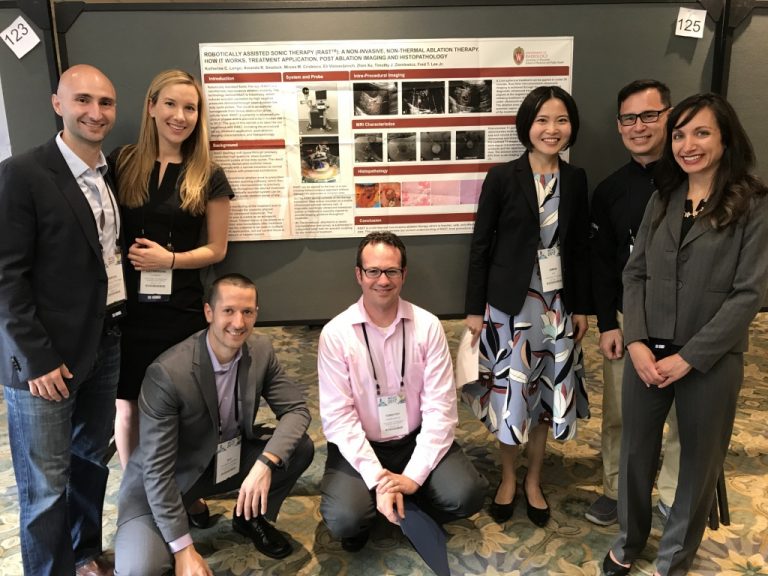
Attending the Zachary Clark Radiology Research Symposium is only one way to support research endeavors by residents and fellows. You can also make a gift to the Zachary Clark Resident Research Fund. Established in memory of Dr. Zachary Clark, January 25, 1986 – March 6, 2017, this endowment supports research performed by the UW School of Medicine and Public Health Radiology residents and ACGME-accredited fellows.